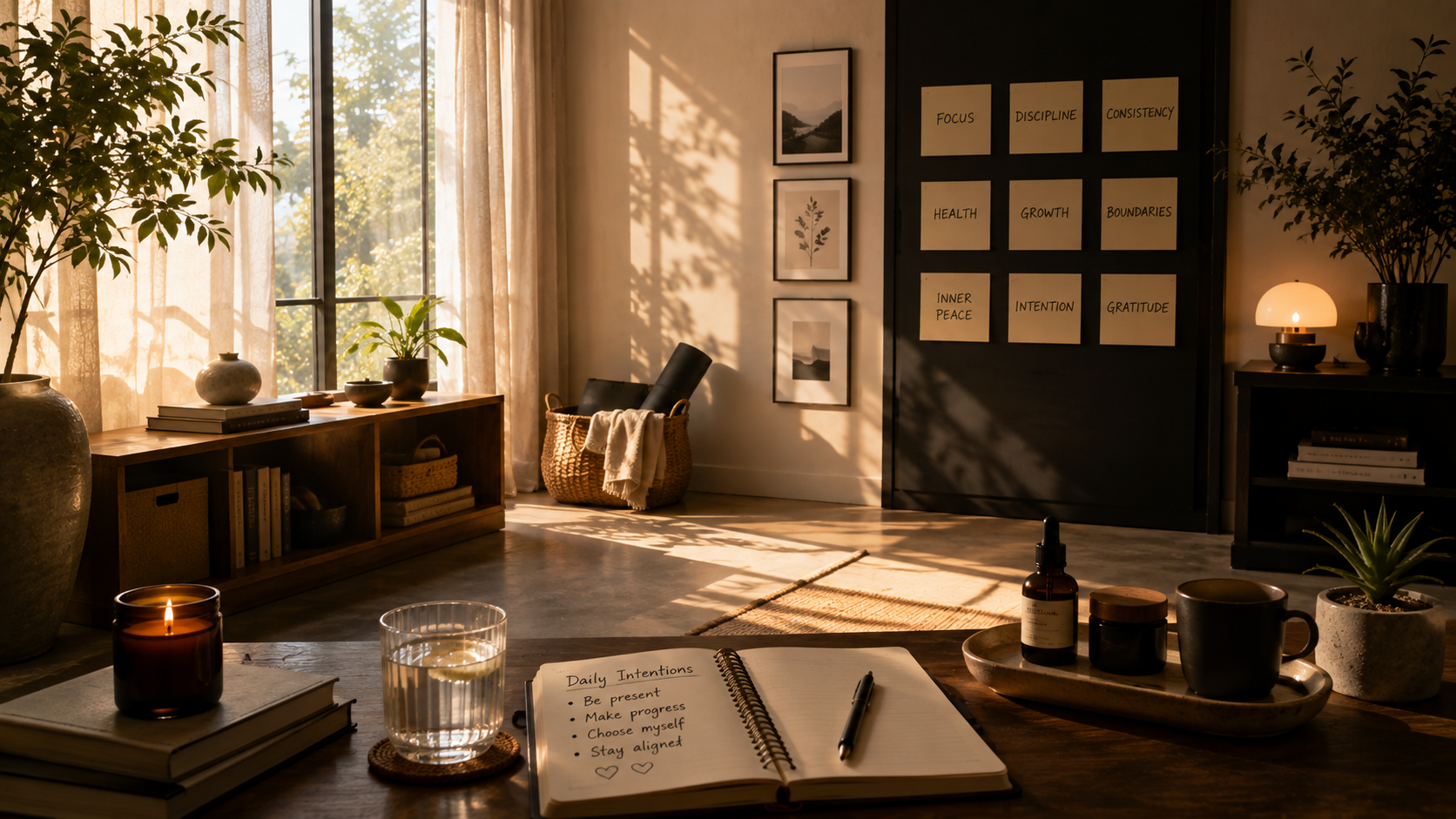
Your Environment Is Participating in Your Self-Mastery
Why the room you are in is an active input, not a neutral backdrop.
“You are not weak for being affected by your surroundings. You are a nervous system doing exactly what nervous systems do: responding, continuously, to everything around them.”
We tend to treat the environment as scenery, the passive backdrop against which the real drama of willpower and character plays out. The overflowing surfaces, the ambient noise, the harsh light, the phone lighting up every few minutes: we experience these as neutral conditions we ought to be able to rise above, and we judge ourselves for the fraying focus and low-grade agitation they produce, as though the fault were entirely internal.
The environment is not neutral, and it is not passive. It is participating.
The Private Theory
Your surroundings are a constant stream of input to your nervous system and your attention, and that input is always doing something: taxing you or supporting you, rarely nothing. Visible clutter reads to the brain as unfinished business and can keep the stress system mildly engaged. In one well-known set of home studies, women who described their spaces as cluttered showed less healthy daily patterns of the stress hormone cortisol, alongside more reported stress and fatigue. The finding is correlational, so read it carefully; it does not prove the clutter caused the cortisol. But it points at something most of us already feel: environment and internal state are entangled, and women in particular often carry the domestic load that makes the entanglement heavier.
So the Private Theory is this. Self-mastery is not conducted in a vacuum against pure willpower. It is conducted inside an environment that is either lending you capacity or spending it. Clutter, noise, lighting, and digital input are not aesthetic preferences. They are load. And because they are load, the intelligent move is not to muster more discipline against a draining room. It is to change the room, so that the discipline is not needed.
The Integrated Lens
Environmental. Visual clutter, noise, and constant digital interruption each place a small, continuous demand on attention and arousal. Individually minor, they accumulate into a baseline of depletion you stop noticing because it never lifts.
Physical. The stress system responds to the space you are in, not only to the events that happen in it. A chronically taxing environment can keep the body mildly braced all day.
Psychological. Blaming yourself for fraying in a draining environment is misdirected. You are not failing to rise above your surroundings. You are correctly registering them. The leverage is in the surroundings, not the self-reproach.
What This Has to Do With Power
To design your environment is to govern the conditions of your own attention and regulation before the day’s demands arrive. This is upstream power, quiet and structural, the kind that removes the need for heroics later. A woman who has shaped her space to support her nervous system has pre-decided a hundred small battles she will now never have to fight through willpower. That is what mastery actually looks like: not winning the fight, but arranging things so the fight never starts.
The Quiet Practice
This week, clear one surface, or silence one stream of digital interruption, and then simply notice the change in your internal state over the following days. You are not chasing a spotless home. You are running a small experiment on how much of your agitation was living in the room rather than in you.
Which of your daily struggles are actually your environment, quietly working against you?
Continue the private study. Subscribe to receive new essays on embodied self-mastery, personal power, nervous system capacity, and the conditions that shape a self-directed life.
Read differently. Live deliberately.
Subscribe to A Private Theory of Power for essays and the introductory email sequence from distinctcharacter.blog. Unsubscribe through any journal email. Privacy Policy.
Source Notes
- Research and clinical literature: Research from UCLA’s study of family homes (Saxbe and Repetti, 2010, Personality and Social Psychology Bulletin) found that women who described their homes as cluttered or unfinished tended to show less healthy daily cortisol patterns and reported more stress and depressed mood. The relationship is correlational and does not establish that clutter causes elevated cortisol.
- Psychological interpretation: The framing of environment as active load and of design as upstream power is the author’s.
- Founder observation: The habit of judging yourself for fraying in a draining room.
© 2025 Distinct Character
Read next: Self-Mastery Begins With Capacity, Not Willpower.